
2. Cosmology & the Rules of Reality

It is clear that a lot of what we will be talking about is going to be the HARD world-building discussed above. Whether a writer documents all the rules and information in some great world bible or just holds them in their mind as they write is up to them.
However, it is likely that as the story progresses, there will be questions that arise, which need answering and will be important to the novel going forward. These answers will need to be consistent with the world created.
And on that note of creation…
Creation myths vs actual cosmology
Does worldbuilding need a creation myth?
‘Probably not’ is a very simple answer, unless it has a direct bearing on the story.
Tolkien is the best example of this type of worldbuilding because, if nothing else, there are all the books in the extended canon that detail every aspect of Middle Earth. There is no doubt that Tolkien wrote and developed every aspect of the world in which his story is set, and it is a richer experience for knowing it all as you read. However, you don’t need to know it all to enjoy Lord of the Rings.
What the writer must decide is whether the world needs that much detail because, when you think about our world, there are a myriad of creation myths, and who is to say which one is true? Or, if all of them are true from a particular perspective. Is it the Norse who got it right, or the ancient Greeks, or the Australian Aborigines? I do like the idea of it all being a dream.
And cosmology is similar, I would suggest. Only worth developing if the writer really needs it.
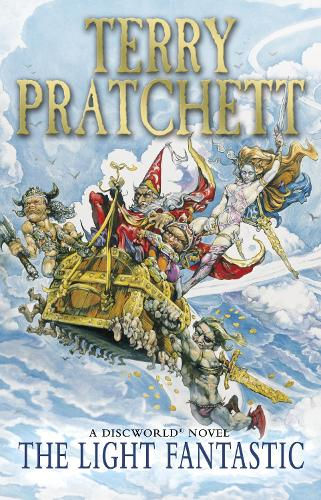
Pratchett is concerned with cosmology. After all, Discworld only works because he thought about and made it an integral part of the story. This absurdist, yet somehow realistic, world works (the only flat-earth model that does).
Gods, planes, and metaphysics
Gods appear in many fantasy books and can be either prime movers of the story or background motivators. Some novels have the antagonist (and protagonist) desire to become a god. Having a pantheon might be just what the world needs, what the story needs to succeed.
However, gods can come with their own set of problems for the writer: ‘omniscient’ and ‘omnipotent’ spring to mind straight away. So, the writer must put limits on what a god can or cannot do.
Will the characters encounter the gods? Will they travel to the planes of existence, and what laws of physics or the supernatural are enforced there? The writer will need to give all of this due consideration before committing words to paper or, rather, text to screen.

Quite often we, as readers, view being a god as the ultimate, but I wonder whether it is the opposite. If you consider what being a god actually means, I come to the conclusion that it might be quite a lonely, powerless existence, with no agency.
How long can a god, like the Greek gods, tinker with humanity for their own amusement before boredom sets in, and boredom can be deadly? Who is your equal to talk to? What can you do when even the twitch of a neuron can decimate a world? Limitless power brings with it the absence of struggle, of goals to aim toward, of stars to reach for when every star is already in your grasp.
Limits, costs, and consistency of magic
Almost all magic systems in all fantasy books and films have a cost to the caster. Why?
Surely, a learned magic user, a wizard, witch, or sorceress, who has dedicated many years to careful study of their art has paid a big enough price for their power.

Consider all those days of lonely academia, hunched over a spellbook or three, with candles providing the only dim, flickering light and long robes brushing candle wax onto parchment, drying into tiny hemispheres which flake off on the rustling turn of a page. Little human contact, few friends, and only the wisdom of the ancients to keep them company. And no, I am not describing my childhood, but rather the archetypal view of mages.
Magic has costs. All power has a cost, though I would cynically add that it is not always the wielder of said power who pays that price, and magic is no different.
The rise of a ‘mad mage’ may have consequences all across the fantasy world: war, famine, death, and disease.

More personally, the magic user may suffer any number of ill effects from their use of power. In many novels, magic is something akin to exercise. The more you do it, the better and strong you become, but you’re still tired out and need a rest.
If you’ve ever worn a Garmin (not a sponsor) watch to run or swim, then you’ll know that once you are finished and it tells your time, pace, and heart rate, it will then tell you how many hours you need to recover before you go again. Obviously, it is an approximate number.
What a great idea for a magic/tech world! Each mage wears a device, a watch, called Magin™ (copyright infringement not intended) that will tell them how long until they can cast magic at full power again. Use magic too often, and eventually you tire and actually lose power. Maybe this is why mages hoard their power? There could be a whole industry set around Magercise™ with supplements, regimes, and the like. You can use that idea. Just give me some credit in the acknowledgements.

Anyway, I digress. Apologies.
Magic has costs. In some worlds, it is to be tired, while, in others, it is to go insane. In some, they turn to dust or become the undead.
Why does there have to be a cost?
Well, there doesn’t. There could be moral and ethical constraints on the use of magic. What about legal constraints to the use of magic? Magical constraints? Of course, all those can be broken, but that creates tension and danger, and that is a good thing in a novel.
There are also novels where magic unrestrained has broken worlds and brought cataclysms and death to millions. The limit of the power is what the world and society can tolerate before they either fight back or are eventually consumed by it.

Consider the superhero versus supervillain dynamic. Does one constrain the other, or does one arise out of the other as a natural consequence of one existing? Either way, they find a balance (amid much destruction and mayhem, normally for the innocent people caught between) with one negating the other. Even Thanos’s ‘snap’ was undone.
Is the magic of the world consistent? Can it only do what it is set up to do, or does the writer break their own rules when they need to? Sometimes it is required, but it can come off as ‘plot armour’, which no one really wants (beyond the wish fulfilment aspect).
In some regards, this comes down to whether the writer has created a magic system based upon natural or supernatural law. Again, we are back to the idea of constraints, checks, and balances.
I’d argue that natural law has constraints, whereas supernatural law has more room to bend those limits.

Natural law, the law of the world and science, has built in limits to what energy, power, and people can do. Even technology runs into limits no matter how advanced it is, and those are a cornerstone of many a science fiction book. Materials can only stand so much impact and so much acceleration, and flesh is a material like any other. Kryptonian flesh has weaknesses. Star Trek, scifi, I know, has technology to overcome acceleration. Gandalf dies (spoilers) but comes back to life (more spoilers). So clearly there are ways around the limitations.
Some of those ‘ways around’ are supernatural. Well, OK, not the Star Trek example, but definitely the Gandalf one. He is a supernatural being, after all.
Where the writer grounds their world, either in natural law or the supernatural, there should be some consistency to it. Nothing will lose the readers more than a writer stepping outside those self-imposed limits to solve a plot problem.
To think about:
Can you think of any stories, novels or series where magic does not have limitations placed upon its use?
Which magic systems do you think are good? What makes them so?
Are there any series where the gods play a major role? How is it handled?
