1. Foundations of a Fantasy World

Updated: Apr 12
What “worldbuilding” actually means (beyond maps and lore)
A world is more than just maps and capital cities, mountains and rivers. A world is everything that surrounds your characters. It is the history and culture, the religions and merchants, the way in which the countries interact with one another, the geopolitics of it all, and how people travel and communicate.
But we don’t have to stop there. Let’s think of other factors that make a world. Think of our own: how we use it and what we do with it. Think of the ancient world, and I do mean the very ancient world – all those aeons that came before the time your story is set.
Is your brain sparking yet?
Think about trade in your world, in our world. Every country has something another country wants, some resource or skill it does better than anywhere else, even if that is just having deep harbours. This is called ‘competitive advantage', and it determines, in each age, who gets rich and who doesn’t. To a degree. I mean, war and conquest go a long way with that, as does, believe it or not, the weather in each place and across the world.
The weather? I hear your soft snort of surprise.

It's too cold, and no one lives there; life is too harsh; no food can be grown. On the edge of these areas, populations grow until they can no longer be sustained without migrating or, even, and hear me out here, raiding other countries for their wealth.
The same for those that are too hot and too wet, where diseases can do a roaring trade and epidemics can wipe out populations. Without stability, without a longer life expectancy, how can a country and its people become wealthy beyond their resources of wood, water, and minerals? Industry, science, and trade become more difficult to progress. Every time there is a plague, copious amounts of money is spent to recover from it, and the country is weakened and ripe for a takeover.
And hot countries are more likely to suffer tropical storms… and so on.
Goldilocks had it right; not too hot, not too cold, but just right.
Alright, let's leave all that aside for now. You’ve got enough to be thinking about.
TOP-DOWN VERSUS BOTTOM-UP
How do you approach building a world? Is there a right way and a wrong way?
No. Not really. Not if you’ve really given some time to think about it.
There are, I would postulate, two main ways of world-building, and which one suits your world and your book is kind of personal and depends on how your brain works. I’ve used both without really recognising them at the time.
TOP-DOWN
Way one is the ‘top-down' approach, and it is how I created the world of the Six Kingdoms. It started with a map.'
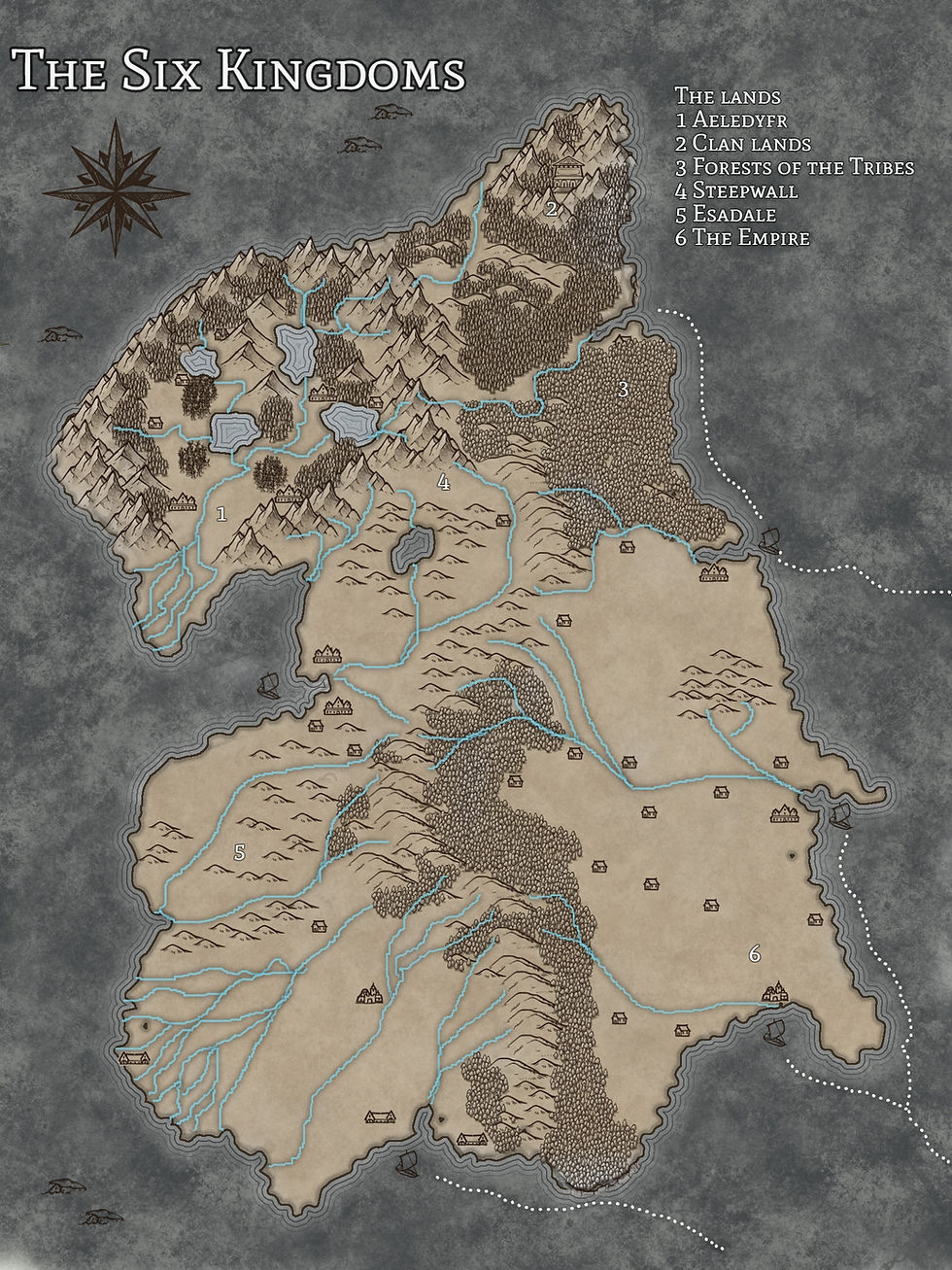
You draw the map of your world or your country and its neighbours. Maybe you don’t draw it all, but you put in the mountains and rivers, the main cities and towns, which are usually next to a river. You have your coastline, and most prosperous countries possess a coastline, fishing villages and trading ports.
You add in the forests, useful for building, and resources, minerals in the mountains and stone quarries. Farmland too. Don’t forget the farms, or how will the people in those great cities of soaring towers and slumlord alleyways actually eat?
Everything is planned and thought about. It is set in, metaphorical, stone.
This method is great for the planners and those who get so involved in building the lore and history of their worlds before they get down to writing it. These writers feel they must know it all before the first word is written; it is a confidence builder and creates rules and boundaries within which to create.
This is a perfectly fine way to world-build.
BOTTOM UP
Way two is the ‘bottom-up' approach. Here you, the writer, have a vague idea about your world, but you know the place where it all begins. Your character wakes up in their village or town, and as they grow in power or traverse the world, it is revealed to the writer.

Some writers will start there, with little pre-thinking, and create an amazing book, a sweeping story that carries the reader from place to place, from battle to battle.
For many of us, we still need to do a little thinking before we start, have some vague ideas about the world and what is outside of the village or how the town works, and a bit about the hierarchy and the magic. Not too much, but enough to get you going.
This method suits the ‘pantsers’ among us. Those who revel in the creative imagination and edge-of-the-seat writers who chase the excitement of not knowing what is going to happen next, or where. I’ve done this. A few times, and it is thrilling.

However, and you knew that was coming, you will reach roadblocks along the way where you must stop and do some research about the particulars of something along the way. How does a tanner make leather? How does a blacksmith make swords and where does the iron come from? How far away is that place you just said the character was going to? And other things too numerous to mention. You’ll find those things out as you go. After all, that’s the fun of it!
This is a perfectly valid way to world-build.
HARD WORLDBUILDING
Much like the top-down approach to worldbuilding, a hard approach to worldbuilding is all about setting the rules by which your world operates. You set out those rules and expectations early on and do not deviate from them. The physics of your world are set; magic systems are created, economic systems interact with purpose, and cultures and languages are all worked out in advance. There is a rich history to your world that plays upon or sets up the story you wish to tell.
Tolkien’s world of Lord of the Rings is an example of top-down hard worldbuilding. There is history going all the way back to the beginning of the world, its creation, the people have myths and sagas from ancient times, the languages are developed, religions are many, and so on.
The reader can feel overwhelmed or very secure in this world depending on how well it is conveyed to them.

SOFT WORLDBUILDING
How can you build a soft world? This is one where nothing is set in stone at the beginning of the book or, dare we say, even by the end of it. Books with soft(er) world-building may not have much consistency and can seem almost dreamlike or underformed. These worlds certainly give an air of mystery to the experience and likely do well as shorter stories rather than sprawling epics.
Most novels, and their worlds, fall somewhere in between these two extremes.
Defining tone, genre, and realism level
You can see a lot of talk about realism in fantasy novels if you read the right online forums. Some readers wish for ultra-realistic stories, some like a little more flexibility in this regard.
Consider your protagonist and the general structure of a novel.

At some point, the hero is going to be beaten up, even wounded and injured. Having them laid up for months on end while they recover may be realistic but might lack a certain pacing to keep the readers engaged. So, in some regards, realism has to be put aside, or massaged a little, to keep the story moving. What other situations are you placing your protagonist in where ultra-realistic systems and consequences will cause problems which cannot be written around?
What is the tone for your world? Is it dark and gritty? Are there humorous moments? Is it a comedic world? These two will have to be consistent across the novel and series.
Think about books you have read. Where do they fit amongst these measures of world-building?
Stick to the big names for now; try to think about their world-building, tone and realism.
Author | Top-down or bottom-up | Hard or soft on a scale of 10 to 1 | Notes on tone and realism |
George R. R. Martin |
|
|
|
J R R Tolkien |
|
|
|
Terry Pratchett |
|
|
|
Robin Hobb |
|
|
|
Sarah J. Mass |
|
|
|